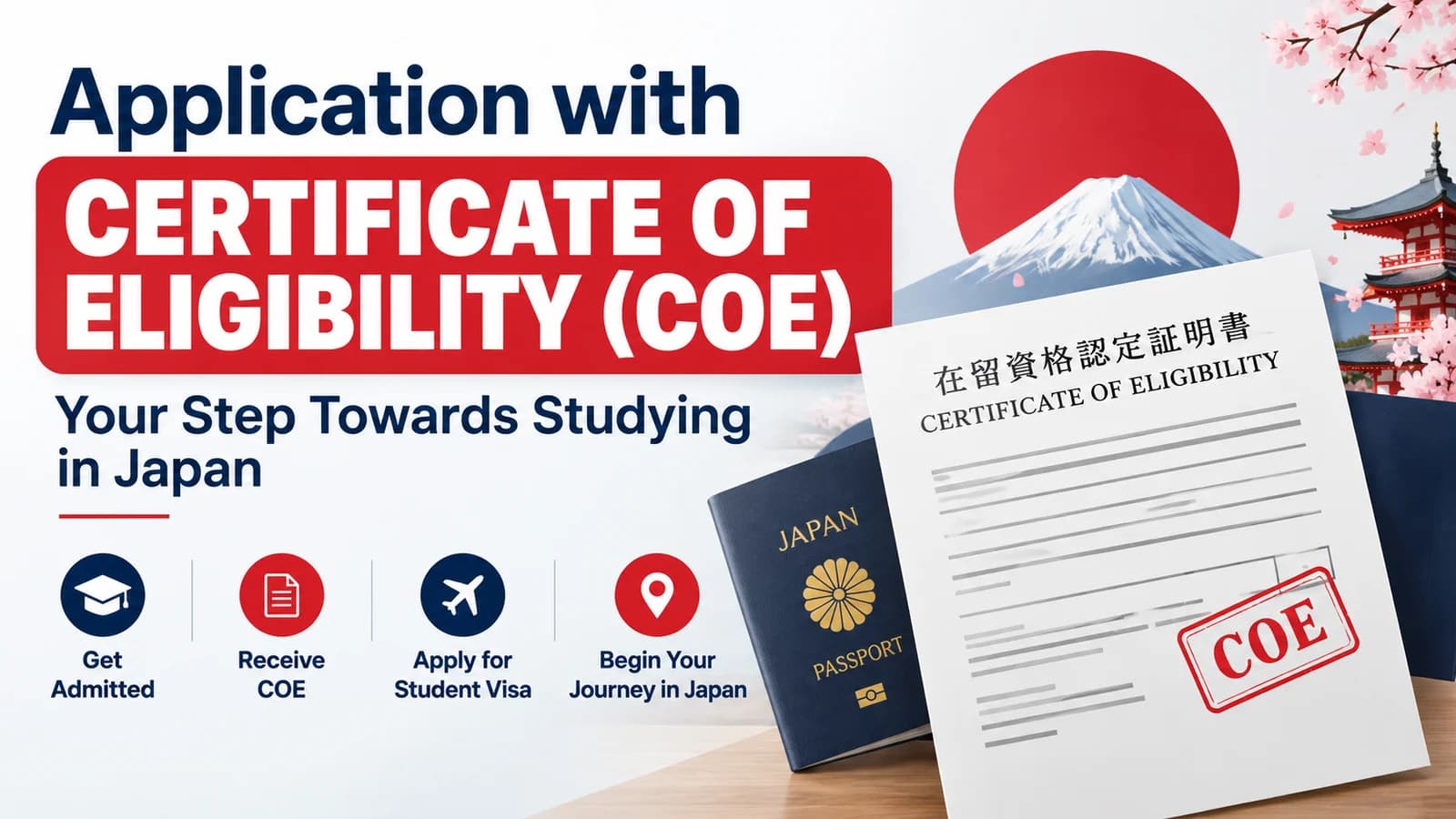
Application with Certificate of Eligibility
Updated on September 16, 2026
Planning to study, work, or settle long-term in Japan? Then there's one document you cannot skip — the Certificate of Eligibility (COE). It's the single most important piece of paper standing between your admission/job offer and your actual Japan visa, yet it's also the step most applicants understand the least.
This guide breaks down exactly what a Japan COE is, who needs it, how the Japan visa application with COE works, what documents you need, and what happens at every stage — based on official Japanese government guidance and real application experience.
Quick roadmap: Invitation/Admission in Japan → COE Applied by Proxy → COE Issued → Visa Application (with COE) → Visa Issued → Travel to Japan
Planning to Study in Japan? Get expert guidance for your COE and student visa process.
📞 +91 8700956038 | ✉️ info@japanvisawithchetan.com
📍 2/81-82, 2nd Floor, Lalita Park, Gali No - 2, Laxmi Nagar, New Delhi - 110092
What Is a Certificate of Eligibility (COE)?
According to official Japanese consular guidance, a Certificate of Eligibility is issued before the visa application by a regional immigration authority under the Ministry of Justice. It serves as evidence that the applicant meets the conditions for landing in Japan — specifically, that the intended activity is genuine and falls under a recognized status of residence (excluding the Temporary Visitor status).
In simple terms: the COE confirms, in advance, that Japanese immigration has reviewed and approved your reason for coming to Japan — whether that's studying, working, training, or joining family — before you even apply for your visa.
Key facts about the Japan Certificate of Eligibility:
- Issued by a regional immigration bureau in Japan, not by an embassy or consulate abroad
- Required for "work" or "long-term stay" purposes — including students, trainees, dependents, and spouses/children of Japanese nationals
- Application can be filed by a proxy in Japan on your behalf — usually your school, employer, or sponsor
- Not required for MEXT (Japanese Government) Scholarship students, who follow a separate route
If you want a deeper breakdown of eligibility conditions specific to students, our Japan Student Visa Requirements guide covers this in detail.
Why Is COE Important for Your Japan Visa Application?
The Japan visa application with COE exists to streamline the process. Instead of every visa decision being made entirely at the embassy stage, Japanese immigration authorities pre-verify your eligibility while you're still in your home country. This means:
- Fewer surprises at the visa application stage
- A clearer, more predictable process for long-term visas
- Confirmation that your inviting party (school/employer/sponsor) is recognized and compliant
Without a valid COE, applying for a long-term Japan visa becomes far more complicated, since the embassy has no advance confirmation of your eligibility.
Get professional guidance with your Japan COE application and student visa process.
Need Help with Your Japan COE? Get professional assistance with your COE and visa application.
📞 +91 8700956038
✉️ info@japanvisawithchetan.com
📍 Laxmi Nagar, New Delhi - 110092
Who Needs a Certificate of Eligibility for Japan?
You'll typically need a COE if your purpose of travel falls under any of these categories:
- Study (university, vocational school, Japanese language school)
- Work (employment-based visas)
- Training programs
- Cultural activities
- Dependent visas (spouse/child of a visa holder)
- Spouse or child of a Japanese national
If you're applying specifically for the Japan COE for student visa, your accepting institution plays a central role — more on that below.
Who Applies for the Japan COE?
This is where most applicants get confused. You do not apply for the COE yourself from India. Instead:
A proxy in Japan (your school, employer, or sponsor) applies on your behalf at the regional immigration bureau with jurisdiction over their location.
For Japan student visa COE applications, this proxy is almost always your accepting educational institution. They submit your documents, respond to any immigration queries, and receive the COE once approved — after which it's forwarded to you.
This is exactly why choosing the right course and having your documentation professionally reviewed before it reaches your institution matters so much. For expert help navigating this stage, our Study Visa Guidance service is built specifically for this.
Japan COE Application Process for Students (Step by Step)
Here's how the Japan COE application process for students typically unfolds:
- Secure admission to your chosen Japanese institution.
- Prepare and submit your documents — academic, personal, and financial — to your school.
- Institution applies for the COE as your proxy at the relevant regional immigration bureau.
- Immigration reviews the application, verifying your eligibility and the legitimacy of your intended activity.
- COE is issued and sent to your institution, which forwards it to you.
- You apply for your Japan visa, submitting the COE along with other required documents.
- Visa is issued, and you prepare for travel.
- Travel to Japan and begin your program.
For a full walkthrough of this journey from application to arrival, check our guide on How to Apply for a Japan Student Visa.
Ready for Your Japan Student Visa? Speak with our experts and start your application today.
📞 +91 8700956038 | ✉️ info@japanvisawithchetan.com
📍 2/81-82, 2nd Floor, Lalita Park, Gali No - 2, Laxmi Nagar, New Delhi - 110092
Documents Required for Japan Visa Application with COE
Once your COE is issued, here's what's generally required for the Japan visa application with COE:
- Completed and signed visa application form
- Recent passport-size photograph (as per specified dimensions)
- Valid passport with sufficient blank pages for the visa
- The original Certificate of Eligibility
- Applicable visa fee (payable once the visa is issued)
- Any supporting documents requested by the consulate handling your application
For students, additional documents commonly requested include:
- Admission/acceptance letter
- Academic transcripts and certificates
- Financial documents (bank statements, sponsor income proof)
- Passport copy and photographs
Since requirements can vary depending on the consulate or visa application centre processing your case, always confirm the latest checklist. Our detailed Visa Application Checklist for Indians is a useful starting reference.
Japan COE Requirements: Academic, Personal & Financial Documents
Breaking this down further, here's what's typically expected across categories:
Academic Documents
- Educational certificates and transcripts
- Admission/acceptance proof
- Language proficiency certificates, where applicable
Personal Documents
- Valid passport
- Passport photographs
- Completed application forms
- Sponsor/family details
Financial Documents
- Bank balance certificates and statements
- Sponsor's income proof (ITR, salary slips, business documents)
- Source-of-funds evidence
- Scholarship documentation, if applicable
Financial documentation is one of the most scrutinized areas of any Japan student visa Certificate of Eligibility application. To understand exactly how much you may need to show, read our detailed guide on the Required Bank Balance for Japan Student Visa.
Confused About the Japan Visa Process? Get personalized guidance for your documents, COE and visa application.
📞 +91 8700956038
✉️ info@japanvisawithchetan.com
📍 2/81-82, 2nd Floor, Lalita Park, Gali No - 2, Laxmi Nagar, New Delhi - 110092
Japan COE Processing Time
There's no single universal processing time for COE applications — it depends on:
- The regional immigration bureau handling the application
- Your intended purpose (study, work, training, dependent, etc.)
- Application volume during peak intake seasons
- Whether additional documents or clarifications are requested
Because of this variability, it's wise to apply well ahead of your intended travel date and stay in close contact with your institution or sponsor for updates on your Japan COE processing time.
Japan COE Validity
Once issued, the COE is valid for a limited period — it does not remain usable indefinitely. This means:
- You should apply for your visa as soon as possible after receiving the COE.
- If too much time passes without a visa application, the COE may lose its validity.
- COE validity and visa validity are separate — one does not extend the other.
Understanding Japan COE validity for student visa applications specifically is important if your admission and travel dates are close together, since delays can affect your intake.
What Happens After COE Approval?
Once your Certificate of Eligibility is approved, the process moves forward like this:
COE Issued → Visa Application Submitted → Visa Processing → Visa Issued → Travel to Japan
At this stage, you (or your consultant) submit the COE along with your visa application form and supporting documents at the Japanese embassy or consulate covering your region of residence.
If you want to understand what typically comes up during the consular interview stage, our Japan Visa Interview Questions guide and Interview Preparation service can help you prepare thoroughly.
Japan Student Visa Process After COE
After your COE is issued, the Japan student visa process after COE generally includes:
- Filling out the visa application form
- Attaching your COE, passport, and photograph
- Submitting academic and financial documents as required
- Paying the visa fee once the visa is issued
- Awaiting visa processing and approval
- Preparing for travel once the visa is stamped
For a complete overview of what Indian applicants specifically need, see our Student Visa Requirements for Indians.
Start Your Japan Visa Journey Today! Contact us for expert Japan visa and COE assistance.
📞 +91 8700956038 | ✉️ info@japanvisawithchetan.com
📍 Lalita Park, Laxmi Nagar, New Delhi - 110092
Common Reasons for Visa or COE Delays and Rejections
Some frequent issues that can affect your Japan COE application or subsequent visa approval include:
- Incomplete or inconsistent documentation
- Unclear or weak explanation of purpose of stay
- Unexplained financial gaps or sudden large deposits
- Missing academic records or unexplained study gaps
- Errors in the application form or passport details
Understanding these risk factors in advance can save you significant time. Read our full breakdown in Reasons of Visa Rejection to avoid common mistakes.
Frequently Asked Questions (FAQs)
What is a Certificate of Eligibility (COE) for Japan?
It's an official document issued by a regional immigration authority in Japan, confirming in advance that an applicant meets the conditions for a specific status of residence before they apply for their visa.
Is COE mandatory for a Japan visa?
For most "work" or "long-term stay" purposes — including students, trainees, and dependents — yes, it's required. MEXT Scholarship students are a notable exception.
Who applies for the Japan COE — the applicant or the school?
A proxy in Japan, typically your school, employer, or sponsor, applies on your behalf at the relevant regional immigration bureau.
How long does the Japan COE take to process?
There's no fixed timeframe — it varies by immigration bureau workload, application type, and whether additional documents are requested.
How long is a Japan COE valid?
It's valid for a limited period, so you should apply for your visa promptly after receiving it to avoid it expiring before use.
What documents are needed for a Japan visa application with COE?
Typically a visa application form, photograph, valid passport, the original COE, applicable visa fee, and any additional documents requested by the consulate.
Can I apply for a Japan visa without a COE?
For most long-term stay categories, the COE is a standard requirement; without it, the application process becomes significantly more complex.
What happens after COE approval?
You proceed to submit your visa application — including the COE — to the Japanese embassy or consulate covering your region.
Is the Certificate of Eligibility the same as the Japan student visa?
No. The COE confirms your eligibility for a status of residence; the visa is the separate document that permits your entry into Japan.
Can students apply for COE without an agent or consultant?
Technically, your institution files the COE application as your proxy, but professional guidance helps ensure your documents are accurate and complete before submission.
Get Expert Help With Your Japan COE and Visa Application
The Certificate of Eligibility process is detailed and unforgiving of small errors — a single inconsistency in your documents can delay your COE, your visa, and ultimately your travel plans.
Japan Visa with Chetan specializes in guiding Indian applicants through the entire journey — from COE documentation to visa application and interview preparation. Whether you're applying for a Japan student visa COE, a work-related COE, or a dependent visa, our team ensures every document is accurate, complete, and submitted correctly the first time.
Explore our full range of support through Documentation Support and Services, or read what past applicants have to say on our Testimonials page.
Looking for Japan Visa Assistance? Get guidance with your COE, documents and student visa application.
📞 +91 8700956038
✉️ info@japanvisawithchetan.com
📍 2/81-82, 2nd Floor, Lalita Park, Gali No - 2, Laxmi Nagar, New Delhi - 110092
Ready to start your Japan COE and visa application the right way?
📞 Call now: +91 8700956038 📧 Email: info@japanvisawithchetan.com 📍 Visit us: 2/81-82, 2nd Floor, Lalita Park, Gali No. 2, Laxmi Nagar, New Delhi - 110092
Have more questions? Visit our FAQ page or Contact Us directly — our team is here to guide you at every step of your Japan journey.